Age-Specific Responses to Protein Ingestion Patterns
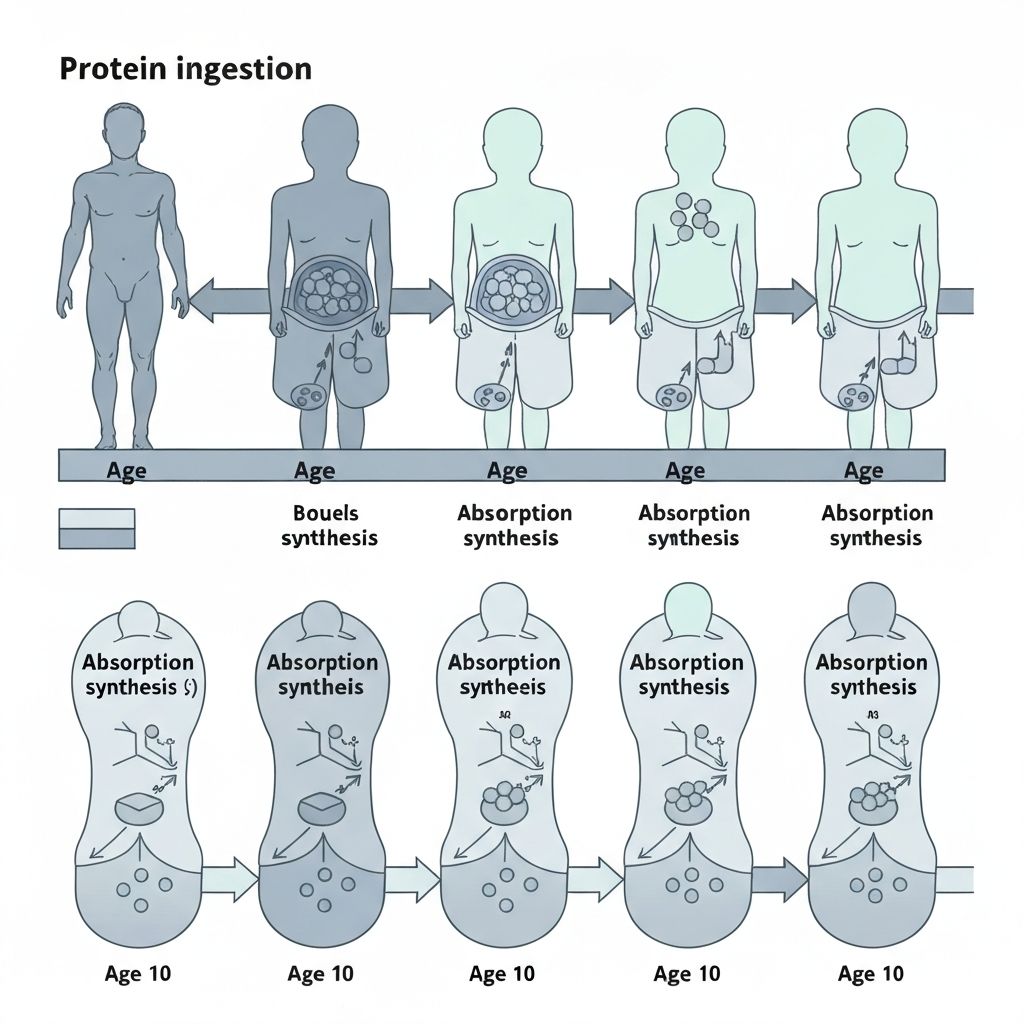
The physiological response to dietary protein varies substantially across the human lifespan. This article synthesizes research findings examining how different age groups respond to varying protein distribution patterns, revealing how chronological age modulates metabolic responses to nutrient intake.
Life-Stage Classification and Protein Research
Research examining protein metabolism across the lifespan typically categorizes populations into distinct age bands, recognizing that physiological responses change across different decades. The primary divisions in nutritional protein research include:
Young Adults (18-35 years)
This population represents the physiological "baseline" in much comparative research. Metabolic responses are typically robust and consistent: rapid MPS responses to dietary protein, efficient amino acid transport into muscle, and sensitive mTORC1 activation. Protein requirements are lower than older populations (approximately 0.8 grams per kilogram body weight daily), and distribution pattern produces minimal effects on net protein balance provided total intake meets requirements.
Middle-Aged Adults (35-60 years)
This transitional population shows early emergence of age-related alterations without the pronounced anabolic resistance evident in older age. MPS responses remain robust but show subtle attenuation compared to younger cohorts. Leucine sensitivity remains generally intact, though minor threshold increases may emerge. Protein requirements gradually increase across this age range but typically remain below older adult requirements.
Older Adults (60+ years, particularly 70+)
This population demonstrates pronounced anabolic resistance across multiple mechanistic levels. MPS responses to protein are substantially attenuated, leucine thresholds are elevated, and amino acid transport efficiency is reduced. Protein requirements increase substantially (approximately 1.0-1.2 grams per kilogram body weight or higher). Distribution pattern becomes increasingly important for optimizing daily protein balance.
Young Adults: Flexible Response to Distribution
Young adults demonstrate remarkable flexibility in responding to different protein distribution patterns. Research feeding identical total protein quantities distributed across 2, 3, 4, or even 5 meals reveals that cumulative 24-hour net protein balance remains relatively constant across these distribution variations. This flexibility reflects robust mTORC1 sensitivity and efficient amino acid transport that permits substantial protein retention efficiency across diverse eating patterns.
Peak MPS rates in young adults show dose-dependent increases: higher protein intakes per meal produce higher peak synthesis rates. However, the total 24-hour synthesis converges toward similar magnitudes provided adequate total daily protein is consumed. This convergence explains why young adults can successfully build or maintain muscle across diverse dietary patterns—the total nutrient quantity matters more than distribution timing.
Immediate Post-Exercise Window
One exception to this flexibility emerges in the immediate post-exercise period. Young adults show enhanced muscle protein responsiveness within 1-2 hours following resistance exercise, suggesting enhanced amino acid transport and mTORC1 sensitivity during this window. Consuming protein in this immediate post-exercise period produces more robust MPS responses compared to identical protein consumed remote from exercise. However, even this effect diminishes when considering cumulative daily balance—the total daily MPS response remains dominated by total protein quantity over timing specifics.
Middle-Aged Adults: Emerging Pattern Sensitivity
Middle-aged adults represent a transitional population where age-related changes progressively emerge. Research comparing protein distribution patterns in this age range reveals early emergence of distribution-dependent effects on net protein balance. While young adults show minimal sensitivity to distribution pattern, middle-aged adults begin showing small but measurable advantages for even distribution at equivalent total protein intake.
The magnitude of these age-dependent distribution effects increases gradually with advancing age through the middle-aged years. A 45-year-old may show minimal distribution sensitivity; a 60-year-old may show measurable effects. This gradual transition reflects the progressive accumulation of physiological changes: increasing leucine thresholds, declining amino acid transport efficiency, and gradual efficiency loss in mTORC1 signaling.
Physical activity status assumes increasing importance in this age range. Sedentary middle-aged adults show more pronounced distribution sensitivity and less efficient protein retention across distribution patterns compared to active age-matched individuals. The interactive effect of activity and age begins to manifest distinctly during middle age.
Older Adults: Critical Sensitivity to Distribution
Older adults demonstrate pronounced sensitivity to protein distribution patterns. The cumulative effects of anabolic resistance produce substantial differences in net daily protein balance between even and skewed distribution at identical total protein intake. This distribution sensitivity arises from multiple converging factors:
Elevated Leucine Thresholds
With thresholds approximately 50% higher than young adults, many standard protein portions fail to achieve adequate stimulus in older populations. More frequent meals providing threshold-exceeding protein increases opportunities for synthesis stimulation. A meal containing 20 grams protein might adequately stimulate MPS in young adults but fall short in many older individuals; ensuring that at least some meals provide 30+ grams protein becomes important.
Extended Negative Balance Periods
Due to attenuated MPS peaks and extended fasting-period protein loss, older adults experience longer cumulative negative balance periods between meals compared to younger adults. More frequent adequate-protein meals interrupt these negative periods, reducing cumulative daily negative balance. The effect becomes particularly pronounced during extended fasting periods like overnight sleep.
Activity-Distribution Interaction
Physically active older adults show less pronounced distribution sensitivity than sedentary peers, suggesting that activity-based stimulation of protein synthesis partially compensates for reduced nutrient-responsiveness. Resistance exercise essentially "primes" muscle tissue to respond more robustly to subsequent protein provision, partially overcoming anabolic resistance.
Research comparing three meals with ~30 grams protein each versus two meals with 45 and 15 grams (equivalent total) in older adults typically shows 10-20% better net protein balance with even distribution. This represents a meaningful difference, not merely statistical artifact.
Comparative Response to Identical Protein Stimuli
When researchers provide identical protein quantities under identical conditions to participants from different age groups, several consistent patterns emerge:
Response Magnitude Decreases with Age
MPS peak height following 20 grams protein shows consistent age-related decline: young adults (25 years) might achieve 45% elevation above baseline; middle-aged (50 years) might achieve 38% elevation; older adults (75 years) might achieve 25% elevation. This age-dependent magnitude decrease is nearly universal across studies.
Response Duration Shortens with Age
Young adults maintain elevated MPS for 120-150 minutes post-protein ingestion. Middle-aged adults show somewhat shorter elevation duration (~100-120 minutes). Older adults often show elevated MPS for only 90-100 minutes. This shortened response window reduces the total synthesis response per meal in older populations even when identical protein is provided.
Breakdown Suppression Differs
Young adults show substantial protein breakdown suppression for 3-4 hours post-meal. Older adults show more modest and shorter-duration breakdown suppression. This reduced breakdown suppression means older adults achieve less benefit to net balance from any single meal through proteolysis reduction compared to younger cohorts.
Higher Doses Reduce Age Differences
When older adults receive higher protein doses (30-40 grams versus young adults' 20 grams), MPS responses often become more similar to young adults. This dose-compensation supports the threshold model of anabolic resistance—higher doses can overcome reduced sensitivity. However, even with supra-threshold doses, older adults frequently fail to achieve identical peak rates as young adults receiving standard doses.
Moderating Factors: Activity, Resistance Exercise, and Intervention
While age-dependent patterns in protein response are consistent, they are not invariant. Several factors substantially modify age-related responses:
Resistance Exercise as Age-Resistance
Perhaps the most striking finding in aging protein research is that older adults maintaining consistent resistance exercise show MPS responses approaching or equaling young sedentary adults. Regular resistance training appears to substantially reverse or prevent age-related anabolic resistance through multiple mechanisms: maintaining mitochondrial function, preserving amino acid transporter expression, and potentially enhancing mTORC1 signaling efficiency.
Leucine Supplementation
Providing supplemental leucine (1-2 additional grams) to standard protein meals enhances MPS responses in older adults more substantially than in young adults. This relatively greater benefit in aging reflects overcoming the elevated leucine threshold—supplementation allows threshold crossing more easily in older populations where endogenous leucine content of food proteins falls marginal.
Inflammation and Health Status
Systemic inflammatory status and various health conditions modify protein response relationships beyond age alone. Individuals with lower inflammatory markers and robust health status show better protein responsiveness than age-matched peers with higher inflammation or chronic disease. This suggests that "biological age" (health/inflammatory status) partially supersedes chronological age in determining protein response patterns.
Longitudinal Age Changes
Most protein research employs cross-sectional designs comparing different age groups at single time points. Fewer longitudinal studies track individuals' protein responses across years or decades. The limited longitudinal data suggest that age-related changes in protein response occur gradually and are partially modifiable through consistent activity engagement. Individuals maintaining high physical activity throughout their lifespan show less pronounced age-related anabolic resistance compared to peers who become increasingly sedentary with age.
This finding underscores a critical point: age-related changes in protein metabolism, while real and consistent, reflect interaction between chronological aging and cumulative lifestyle factors, particularly physical activity patterns. Some age-related changes may be intrinsic to biological aging; others appear preventable through sustained activity.
Summary of Age-Specific Response Patterns
Young Adults (18-35): Distribution Flexibility
Robust responses to protein across diverse distribution patterns; flexibility in eating schedules; lower absolute protein requirements. Distribution pattern importance: minimal.
Middle-Aged Adults (35-60): Gradual Pattern Sensitivity Emergence
Gradually increasing age-related changes; beginning evidence of distribution sensitivity; increased activity importance. Distribution pattern importance: gradually increasing.
Older Adults (60+): Critical Distribution Sensitivity
Pronounced anabolic resistance; substantial distribution sensitivity; elevated protein requirements; high activity importance for maintenance. Distribution pattern importance: critical.
Conclusion
Age-dependent variations in protein response to different ingestion patterns represent one of the clearest examples of how human physiology changes across the lifespan. Young adults demonstrate flexibility in achieving net protein balance across diverse eating patterns. Middle-aged populations show transitional emergence of distribution sensitivity. Older adults demonstrate pronounced sensitivity to protein distribution and higher absolute requirements for maintaining protein balance.
These age-dependent patterns reflect cumulative physiological changes in amino acid sensing, transport, and signaling. Importantly, many of these changes appear partially modifiable through consistent physical activity. Understanding age-specific protein response patterns permits more tailored consideration of dietary patterns across the lifespan while recognizing both age-dependent changes and the substantial modifying influence of activity status and health maintenance.
Educational content only. This article presents scientific explanations without offering individual recommendations or guarantees regarding personal outcomes.
Back to research articles