Anabolic Resistance in Ageing: Protein Dose Implications
Anabolic resistance describes the physiological phenomenon where older adults demonstrate diminished muscle protein synthesis responses to equivalent doses of dietary protein compared to younger populations. This article examines the biochemical basis of anabolic resistance and explores implications for understanding protein requirements across the lifespan.
Defining and Measuring Anabolic Resistance
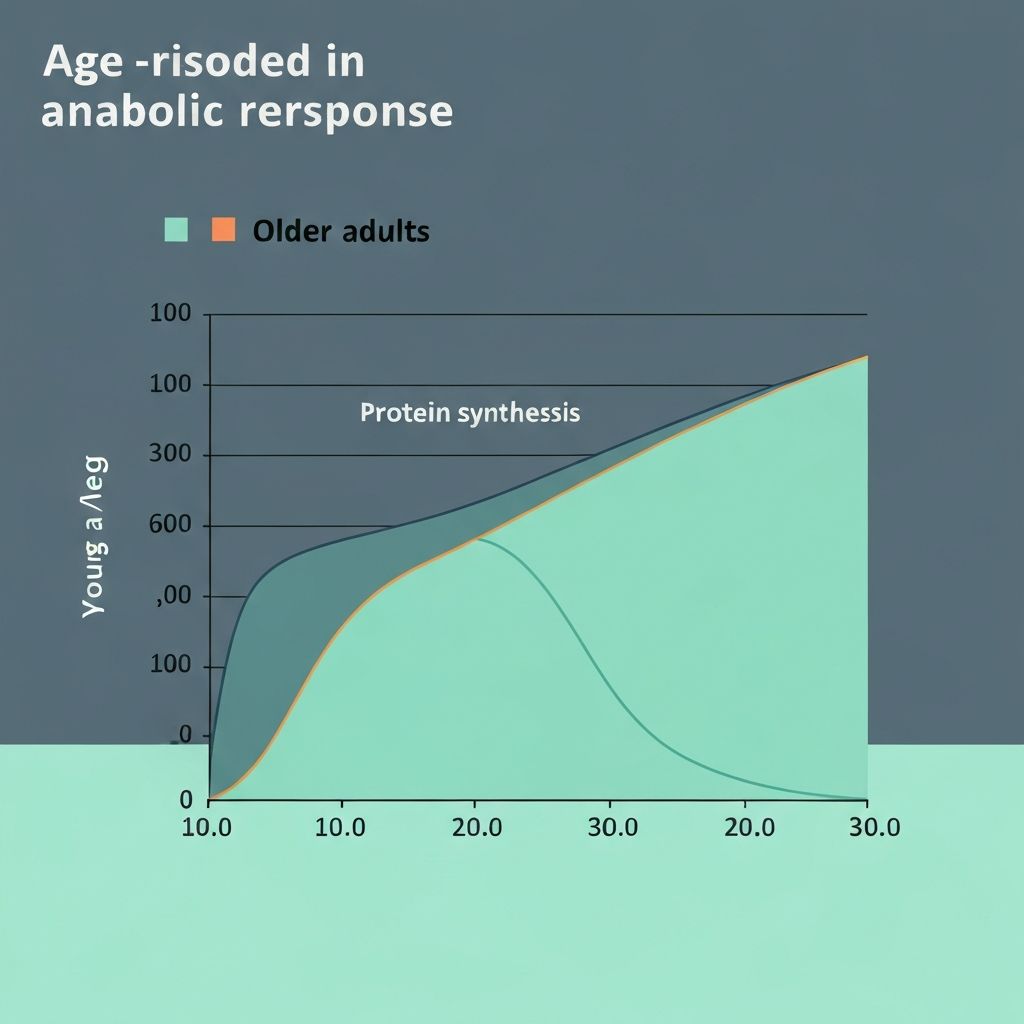
Anabolic resistance emerges as a measurable difference when research compares muscle protein synthesis responses in young versus older adults consuming identical protein quantities under identical conditions. A typical experimental comparison might involve young adults (20-30 years) and older adults (70-80 years) consuming 20 grams of high-quality protein. The young cohort demonstrates a robust MPS elevation beginning 20-30 minutes post-ingestion, peaking around 60-90 minutes, and returning toward baseline within 120-150 minutes.
The older cohort consuming identical protein demonstrates: delayed onset of MPS elevation, lower peak synthesis rates, and more rapid return to baseline. Quantitatively, the MPS area under the curve—representing integrated synthesis activity—is substantially lower in older adults despite identical nutrient intake.
This difference is not absolute resistance (complete absence of MPS response) but rather a relative attenuation. Older adults respond to dietary protein; the response is simply less pronounced than in younger populations. This distinction proves important for interpreting the practical significance of anabolic resistance.
Biochemical Mechanisms Underlying Anabolic Resistance
Investigation into the biochemical basis of anabolic resistance has identified multiple contributing processes, each representing an age-related alteration in muscle physiology:
Reduced Leucine Sensitivity
The Sestrin2 protein and related leucine sensors show age-related changes in sensitivity. The molecular interaction between leucine and Sestrin2 appears less efficient in older adults, reducing the activation signal transmitted to mTORC1. This manifests as a higher threshold—older adults require higher leucine concentrations to achieve equivalent mTORC1 activation compared to younger adults.
Altered Amino Acid Transport
Transport of amino acids across muscle cell membranes depends on specific transporter proteins embedded in the cell membrane. Age-related changes in expression and function of amino acid transporters reduce the efficiency of amino acid uptake into muscle tissue. This means that for identical circulating amino acid concentrations, older adults accumulate lower intramuscular concentrations, reducing the stimulus for protein synthesis.
Impaired mTORC1 Signaling
The efficiency of mTORC1 in activating downstream translation factors appears to diminish with age. Even when mTORC1 achieves activation, the downstream cascade producing elevated translation rates shows reduced responsiveness in aged muscle tissue. This suggests age-related alterations in the signaling network downstream of the initial leucine sensor.
Mitochondrial Dysfunction
Protein synthesis requires substantial ATP energy to drive the ribosomal machinery. Age-related changes in mitochondrial number and function reduce ATP generation capacity in muscle cells. Limited ATP availability may constrain the rate at which protein synthesis can proceed even when the signaling machinery is activated.
Age-Dose Response Relationships
Research examining dose-response relationships in older versus younger adults reveals important patterns. When older adults receive higher protein doses (30-40 grams) compared to younger adults receiving 20 grams, the MPS responses often become more similar. This suggests that anabolic resistance primarily manifests through increased thresholds rather than absolute refractory responses.
However, even with substantially higher protein doses, older adults frequently fail to achieve identical peak MPS rates compared to younger adults receiving standard doses. This indicates that anabolic resistance operates through multiple mechanisms—not solely through threshold effects but also through reduced responsiveness at supra-threshold stimulus levels.
Dose-Threshold Effects
Studies comparing MPS responses across protein doses reveal that the leucine threshold may increase from approximately 2.5-3 grams in young adults to 3-4 grams in older adults. This approximately 25-50% increase in threshold means that meals providing adequate leucine for young adults may fall short of the activation threshold for older populations.
Beyond threshold, the slope of the dose-response relationship—how much MPS increases for each additional gram of protein—appears less steep in older adults. This reflects the multi-level changes in signaling efficiency identified above.
Physical Activity as a Modifier of Anabolic Resistance
The magnitude of anabolic resistance is not fixed across the older adult population but rather varies substantially based on physical activity status. Older adults maintaining regular, particularly resistance-type, physical activity demonstrate markedly reduced anabolic resistance compared to sedentary age-matched peers. In some studies, physically active older adults show MPS responses approaching or equaling those of younger sedentary adults.
This finding suggests that anabolic resistance is not purely a consequence of biological aging but rather reflects a combination of age-related changes and disuse-related deconditioning. The muscle tissue itself appears to retain substantial responsiveness to mechanical stimulus and nutrient provision; loss of this responsiveness predominantly reflects the effects of physical inactivity.
Mechanistically, physical activity appears to operate through multiple pathways: maintaining mitochondrial function, preserving amino acid transporter expression, and potentially preserving mTORC1 signaling efficiency. Additionally, mechanical muscle stimulation from resistance exercise may prime muscle tissue to respond more robustly to subsequent nutrient provision.
Protein Distribution Considerations in Older Adults
Anabolic resistance carries implications for considering protein distribution across meals in older populations. Since each meal produces a smaller MPS response in older adults compared to younger populations, a distribution pattern ensuring that multiple meals during the day meet the elevated leucine threshold may provide advantages in accumulating adequate total daily MPS.
Multiple Threshold Crossings
If older adults require approximately 3-4 grams of leucine to achieve adequate mTORC1 activation, consuming this quantity at three or four meals throughout the day provides multiple opportunities for MPS stimulation. While each meal-induced synthesis response may be smaller than in younger adults, the cumulative daily impact of multiple adequate stimuli may better support daily protein balance compared to concentrated protein intake in fewer, larger meals.
Timing Relative to Activity
Coordinating protein intake with or shortly after periods of physical activity appears particularly important in older adults. The MPS elevation produced by mechanical muscle stimulation combines synergistically with nutrient-based signals; consuming adequate protein in close temporal proximity to exercise produces supra-additive MPS responses compared to exercise or protein alone.
Interventions Targeting Anabolic Resistance
Research exploring potential interventions to reduce anabolic resistance has identified several approaches showing promise in research contexts:
Leucine Supplementation
Providing supplemental leucine beyond that naturally present in food-based protein can enhance MPS responses in older adults, particularly in sedentary populations. This approach capitalizes on the higher leucine threshold in aging by delivering supraphysiological leucine concentrations that overcome reduced sensitivity to normal physiological amounts.
Resistance Exercise
Regular resistance-type physical activity represents the most extensively supported intervention for reducing anabolic resistance. The combined stimulus of mechanical loading and adequate nutritional support produces robust MPS responses even in advanced age. This suggests that anabolic resistance is substantially reversible through activity-based interventions.
Optimization of Meal Pattern
Ensuring adequate protein in multiple meals throughout the day, coupled with appropriate spacing to allow post-absorption recovery, represents a practical intervention based on nutritional physiology principles. While individual meal responses may be attenuated, cumulative daily synthesis may be optimized through thoughtful distribution.
Conclusion
Anabolic resistance in aging reflects genuine physiological alterations in how muscle tissue responds to dietary protein stimuli. This resistance is not absolute but rather manifests through increased activation thresholds and reduced peak responsiveness. The magnitude of anabolic resistance varies substantially based on physical activity status, suggesting that aging-associated reductions in muscle protein synthesis responsiveness result from interaction between age-related biological changes and disuse-related deconditioning.
Understanding anabolic resistance provides context for interpreting research on protein requirements and distribution patterns in older populations. The mechanisms underlying this phenomenon—leucine sensitivity, amino acid transport, signaling efficiency—suggest multiple potential targets for interventions aimed at supporting muscle health in aging.
Educational content only. This article presents scientific explanations without offering individual recommendations or guarantees regarding personal outcomes.
Back to research articles